The cost of opening a board game café in DC

I’ve been interested in opening up a board game café in DC for a while. While I estimate that there is enough interest in board games in DC to sustain 10 or more board game cafés, I’m concerned about the difficulty of making a game store financially sustainable while it is getting established. Advertising a new store is going to be hard and it is going to be a while before the cafe earns enough to cover expenses.

In Virginia, I’ve noticed multiple game stores close, including Compleat Strategist and Game Parlor, and rents tend to be cheaper than DC.

This post is a rough estimate of how much it will cost to run a board game store in DC. It will be a lower bound as it does not consider taxes, or miscellaneous costs such as paying for electricity and permit fees. Also, I’ll be using lower bound values for a likely best case scenario.

-Monthly rent: $4.5/square foot

-Size of place: 400 square feet.

-Yearly rent : 4.5*400*12 = $21,600

Salary costs

On weekends, I’d like to keep the place open from 9am to 12pm, and from 4pm to 12pm on weekdays, which is 70 hours. When factoring in 2 hours per day for opening, closing, and maintenance, 84 hours are needed. While many restaurants close earlier, I do want to keep the game store open until midnight. This gives people an opportunity to stay and socialize for a while instead of having to quickly leave due to an early closing time. Assuming that 2 people would be working at all times, that is a cost of $20,160 a month, or $241,920 each year.

  • Minimum monthly salary: $25*40*4 = $4000
  • Monthly health insurance cost: $800

A lower bound on the costs of rent and salaries would be $263,520 per year. This number is likely to be significantly higher when considering the other costs. I’m not willing to compromise on customer service, paying employees, or employee benefits.

I would rather see policy changes that reduce the costs of running a small business, such as a vacancy tax that would lower rents.

One possible solution may involve several other people trying to start board game cafés at the same time. Due to the amount of interest in board games, they aren’t going to be competing with each other or other board game stores or cafés. On the other hand, we can work together in many ways including sharing advice on running a board game café or negotiating bulk discounts on games.

We could also work together to advocate for policies that make a board game café more sustainable. One example would be increasing financial penalties for vacant storefronts in DC, which would encourage landlords to rent space to small businesses at lower rates. I’ve seen many storefronts that have been vacant for years that are in great locations near Metro stations.

Vanilla PHP is great

I am working on a proof of concept for a public event aggregator which will allow users to search for events from multiple sites.

I decided to use vanilla PHP for the aggregator due to simplicity. While I haven’t worked with PHP in a while, I remember PHP being relatively straightforward to setup and deploy. PHP is well tested due to decades of development, and it is still widely used, which is another indication of it’s usefulness. The aggregator will work by retrieving data from multiple sources and then converting it into HTML, which is a great fit for a PHP proof of concept.

An added bonus of using vanilla PHP is that there is a variety of great documentation, which is mostly been written before AI generated documentation became widespread.

While this setup isn’t optimal from a performance perspective, it does allow for improvements to be easily added. One option would be to use PHP in memory caching to cache data. Local sites could also be configured to call a PHP API endpoint to submit updates to the aggregator, which would run a separate script to save data to the cache. A database could also be added later.

A PHP framework such as Laravel, or a framework in another language such as Ruby on Rails, Django, or Spring Boot can be more powerful when it comes to additional features such as handing use authentication. From an engineering perspective, I think Java is a better language for a backend, and one could say the same about other languages.

Higher engineering quality is important for software where security and avoiding bugs is more important than codebase accessibility. Examples include software running on medical devices, or a security software used to control access to government buildings. An accessible codebase could make it easier to find and exploit security flaws, and lower quality software increases the risk of bugs.

However, I think vanilla PHP is a better solution for an aggregator website despite lower engineering quality. Setting up an aggregator website using Java involves additional complexity when compared to PHP for deployments. When deploying the Java API for dmvboardgames.com, I had to setup a Docker container and logic to start a server, which was not necessary with the way Digital Ocean supports PHP deployments. When learning PHP, I also remember being able to upload PHP files to a shared hosting server on bluehost.com and have them run without any additional setup. There is also the additional complexity of setting up another server or the Java server to serve HTML.

The aggregator proof of concept is to demonstrate the decentralized in event hosting platform I am working on. One key goal is to get more people involved with making websites for in person events. The aggregator code is open source, and I want people to use it as an example to build their own event websites.

How AI Destroys Institutions

https://papers.ssrn.com/sol3/papers.cfm?abstract_id=5870623

This paper specifically refers to generative AI, predictive AI, and automated decision systems.

I’ve seen this happen many times to software projects that are prioritizing generative AI over producing customer value. For example, GitHub.com keeps trying to push generative AI features while making the UI more bloated and not prioritizing user experience issues. One example is not providing a way for projects to block AI generated code contributions that do not meet quality standards.

I’m in the process of moving from GitHub.com to Codeberg.org for open source development, and I plan to stop using GitHub entirely once I get time to replace my GitHub deployment pipelines. Development of the Zig programming language has moved from GitHub to Codeberg, citing a decline in quality. (Source)

Slowing down coding speed can be beneficial

Earlier this week, I decided to try using Vim instead of an IDE for working on createthirdplaces.org. My coding speed has slowed down significantly as I am not used to Vim. I think the slowdown is somewhat of a benefit right now.

  • Right now, I am prioritizing user experience by displaying pages in a way that makes sense for users, and making sure information is organized in an intuitive way. As part of this process, I’m thinking about the user feedback I have received recently. Slowing down is helping me think carefully about the changes I am making to ensure that they are addressing feedback.
  • Slowing down makes it less likely that I am producing too much content. Too much visible content overwhelms users. If I can improve the user content by making it less visible, that means users are unlikely to see the content, and working on that content probably did not need to be a priority.

Automating human communication will probably make customer service worse

I often hear that automating human communication in ways such as adding self checkout lines, an online chatbot, or an automated phone answering system improve customer service. I think the opposite is usually the case.

Companies which automate customer interactions have a variety of goals besides customer service, especially making a profit. Humans in customer service roles will have empathy for the customer, regardless of what their company training says. Companies have far more control over how a customer service bot is trained, and can design them to make profits a priority, without any empathy for customers. Customer service bots can also be used to giving the appearance of providing customer service, without having to pay a human.

Using a automated ordering system at a restaurant instead of talking to a cashier or having to use a customer service bot feels very depersonalizing. I’m also reminded of people who lost their jobs, while the cost of food, healthcare, and housing is going up. I prefer the inefficiency of not having automated checkout systems or customer service bots. Also, I think adopting more pro-human values is a necessity as technology advantages.

While I think it would be ideal to not automate customer service, sometimes automation of customer service can be a necessity. A small business such as a local coffee shop may not be able to earn enough to pay for fully human customer service. There are various overhead costs such as buying food, and paying rent.

Between 1983 and December 2025 overall prices in US urban areas rose by 326.03%. On the other hand the cost of food in urban areas rose by 344.693%. The cost of shelter rose by 420.983%, which means customer service need more money, and high housing costs does correlate with high rents for commercial establishments. With restaurant margins between 0-15%, even relatively small cost increases can cause a restaurant to go out of business or automate customer service to save money. On the other hand, the cost of IT hardware and services has gone down by 93.292% since 1988, and this is a key reason why automation increases profits.

Due to the relative cost of human customer service compared to automation, trying to convince people to prioritize human customer service over automation using an efficiency argument is not going to work. I think it’s better to focus on saying human customer service is better because, customers will get a better experience, automation related job disruption will be reduced, and we promote more prosocial norms that help us effectively manage new technology.

To summarize, automation will probably make customer service worse, and we should promote more prosocial norms to encourage human customer service.

Grocery stores and self checkout

As an example, I prefer getting groceries at Trader Joe’s over Safeway. One reason is the fact that Trader Joe’s locations I’ve been to do not have any self checkout counters. On the other hand, the Safeway near me has self checkout, and sometimes self checkout is my only option. Ratings of the Trader Joe’s near me are also significantly higher than the ones for Safeway, which is a sign that people see Trader Joe’s as a grocery store that provides better customer service.

I’ve also noticed that employees at Trader Joe’s also appear to be happier and provide better customer service. Employees at Safeway tend to be unhappy and checked out. To me, this is a sign that Trader Joe’s treats it’s employees better. Trader Joe’s having better employee reviews on Glassdoor and Indeed is another sign. I don’t think it’s a coincidence that all of the Trader Joe’s I’ve been to employ human cashiers and do not use self checkout.

Not using checkout is also representative of management’s concern for customers and employees. I think one significant cause of the fact that Trader Joe’s treats it’s employees better and has better customer service is the humanizing effects of having people work as cashiers. Also, it means that management made a decision to not use self checkout. On the other hand, Safeway’s management deciding to use self-checkout does show a lack of concern for customers and employees.

On the other hand, prices at Safeway are significantly lower. As a result, I still buy groceries at Safeway, despite the fact that I do not want to use self checkout. Lower prices is probably also a reason why other people buy groceries at Safeway.

Here is a comparison of prices for some food items at Safeway and Trader Joe’s as of January 2026.

FoodTrader Joe’sSafeway
1 banana$0.23 $0.25
12 eggs$5.99$4.99
Milk carton(64 Fl Oz)$5.99$2.99
Canned tomatoes$1.49$1.99

https://www.glassdoor.com/Overview/Working-at-Safeway-EI_IE581.11,18.htm

https://www.glassdoor.com/Overview/Working-at-Trader-Joe-s-EI_IE5631.11,23.htm

https://www.traderjoes.com/home/search?q=&global=yes

https://www.safeway.com/shop/search-results.html?q=12%20eggs&tab=products

https://www.indeed.com/cmp/Trader-Joe%27s/jobs

Average reviews for nearest Trader Joe’s and Safeway to my place.

WebsiteTrader Joe’s ratingSafeway rating
Google Maps4.6 stars3.6 stars
Yelp4.2 stars2.3 stars

Sources on inflation and restaurant profit margins

https://fred.stlouisfed.org/series/CPIAUCSL

https://fred.stlouisfed.org/series/CPIUFDSL

https://fred.stlouisfed.org/series/CUUR0000SEEE


https://fred.stlouisfed.org/series/CUSR0000SAH1

https://merchants.doordash.com/en-us/blog/profit-margins-restaurant-businesses

https://www.restaurant365.com/blog/what-is-the-average-profit-margin-for-a-restaurant-2

https://pos.toasttab.com/blog/on-the-line/average-restaurant-profit-margin?srsltid=AfmBOooSbQLw0lcXziUbdBoE0D7dmzcGcOK4wQuoY1_vOthfxn4acTTF

Here are some links I think are relevant

https://en.wikipedia.org/wiki/Baumol_effect#

https://www.unesco.org/en/articles/baumols-cost-disease-long-term-economic-implications-where-machines-cannot-replace-humans

https://www.strongtowns.org/journal/2026-1-12-christmas-cookie-inflation-index-2025-update

Improved technology is going to require more human centered values and communication

As technology advances, the idea that we can use technology to replace human interaction is misguided. This is not related to how advanced technology becomes, and I think it will be true, even in a theoretical world where AIs were smarter than humans.

As technology becomes more advanced, the scale of it’s impact will be larger, and we need to make sure it is used for constructive purposes instead of destruction. This requires humans to work together and develop social norms around how technology is used. For example, nuclear fission was used in the 1940s to develop nuclear weapons, which have become powerful enough to turn our planet into a lifeless wasteland. However, there is also a collective understating that nuclear weapons should not be used in war, and nuclear fission is now used in power plants to generate electricity. While nuclear power plants are complicated and generate radioactive waste, they are also far more energy efficient and generate less air pollution than coal plants.

When it comes to communication, technologies that facilitate communication when it otherwise isn’t possible have made the most positive impact. Being able to make a phone call or send an email to someone who isn’t physically in the same room as you has been very beneficial for society.

Sometimes, promoting human centered values is going to require avoiding use of a technology, even if the technology makes work more efficient. For example, AI art generators can generate art far more efficiently than a human artist. However, AI art generators lack empathy and the ability to connect with an audience, so using them moves us away from human centered values that are becoming increasingly important. AI art generators are also trained on the work of artists without permission, financial compensation,or credit, which is anti-human. In other words, we should be supporting human artists.

Also, technology is developed and maintained by humans that have to communicate and work together. Nobody is able to develop new technology entirely on their own with no help. First of all, you need to talk to potential users to see if what you are making will solve a problem they care about. Once the technology is developed and proven to be useful, you then need to convince people to use the technology. Then, you will need user feedback about bugs, new features, and places where the user experience needs to be updated. Successful technologies such as electronic computers are rarely created in isolation, released to users, and then never modified again.

One more reason task-specific models are the future of AI

Researchers at Goodfire AI isolated memorization from problem solving in large language model(LLM) neural networks.

I think this is additional evidence of the fact that LLMs are very inefficient in a manner similar to blockchain. Blockchain was capable of solving real world problems by wasting large amounts of energy. However, the inefficiencies of blockchain weren’t being covered up by billions of dollars in subsides and exploitation of low wage workers.

If problem solving is isolated from memorized data, that means that it would be more efficient to use a model that is dedicated to solving problems without needing to memorize facts. Training an LLM takes time and resource, especially if it is being trained on problems that are irrelevant to one’s work.

The isolation of problem solving implies that an LLM has the capability to categorize data and place the data in different parts of a model. As a result, problem solving capabilities for different subjects would also be split up. If a model is trying to reason about astronomy, it wouldn’t make sense for the model to be influenced by facts about history. which means that LLMs would use different model sections to reason about the two subjects.

If one wants to use an LLM to look up facts, it would be more efficient to use one that is just trained on memorized data without any reasoning abilities. Also, tools such as Wolfram Alpha have existed for years to provide information about memorized facts, and they don’t make up information like LLMs sometimes do.

To put things into perspective, I have been regularly benefiting from AI when riding the Red Line of the DC Metro. It now uses automated train control(ATC) to drive trains, which has made train rides smoother. This is an example of task-specific AI, that works 100% of the time, and the ATC developers were able to save time by ignoring irrelevant data.

Sources

https://arstechnica.com/ai/2025/11/study-finds-ai-models-store-memories-and-logic-in-different-neural-regions

https://arxiv.org/abs/2510.24256

Fixing a bug with displaying the next recurrence of a weekly event with the help of automated testing.

On the morning of Sunday, November 9th, 2025, I deployed an update to dmvboardgames.com to show information about groups a user joined and dates of recurring events that a user had an RSVP to attend.

I navigated to my user page shortly afterwards in the morning and saw that it was showing Sunday, November 16th as the next event date for the two events I host on Sundays. Since the current date was November 9th, the next event dates should’ve been displayed on November 9th.

I narrowed down the root cause to the following line of code on the backend. It made the next event date 7 days in the future if the user member page was accessed on the day of an event, regardless of whether the current time was before or after the event start time.

LocalDate nextEventDate = LocalDate.now().with(TemporalAdjusters.next(DayOfWeek.valueOf(eventDay.toUpperCase())));

The test also had the start date in the future. I added a pause if the test was being run at midnight and rewrote the test case with the following code.

LocalDate expectedDate = LocalDate.now();
LocalDate startDate = eventFromDb.getStartDate();
assertEquals(expectedDate, startDate);

Then I rewrote the next event date calculation.

LocalDate nextEventDate = LocalDate.now();
DayOfWeek eventDayValue = DayOfWeek.valueOf(eventDay.toUpperCase());
if(!eventDayValue.equals(nextEventDate.getDayOfWeek())){
nextEventDate = nextEventDate.with(TemporalAdjusters.next(eventDayValue));
}

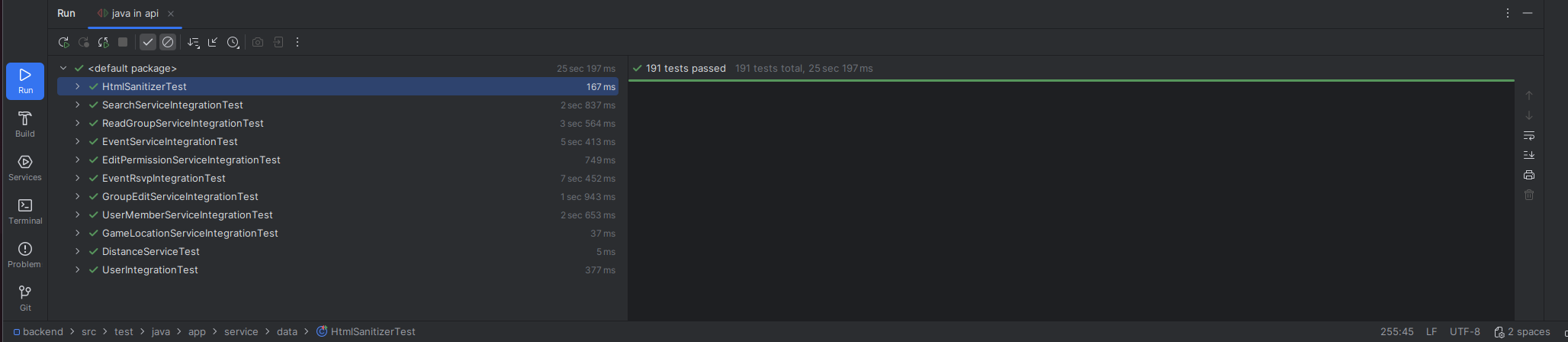
Afterwards, the test passed.

I then added another test case for an event that was on a day that wasn’t the current one.

After fixing another test case that was incorrectly using the next day as a next event occurrence, all the tests passed.

I merged the changes to the main branch, then deployed to the release branch, and created a new release.

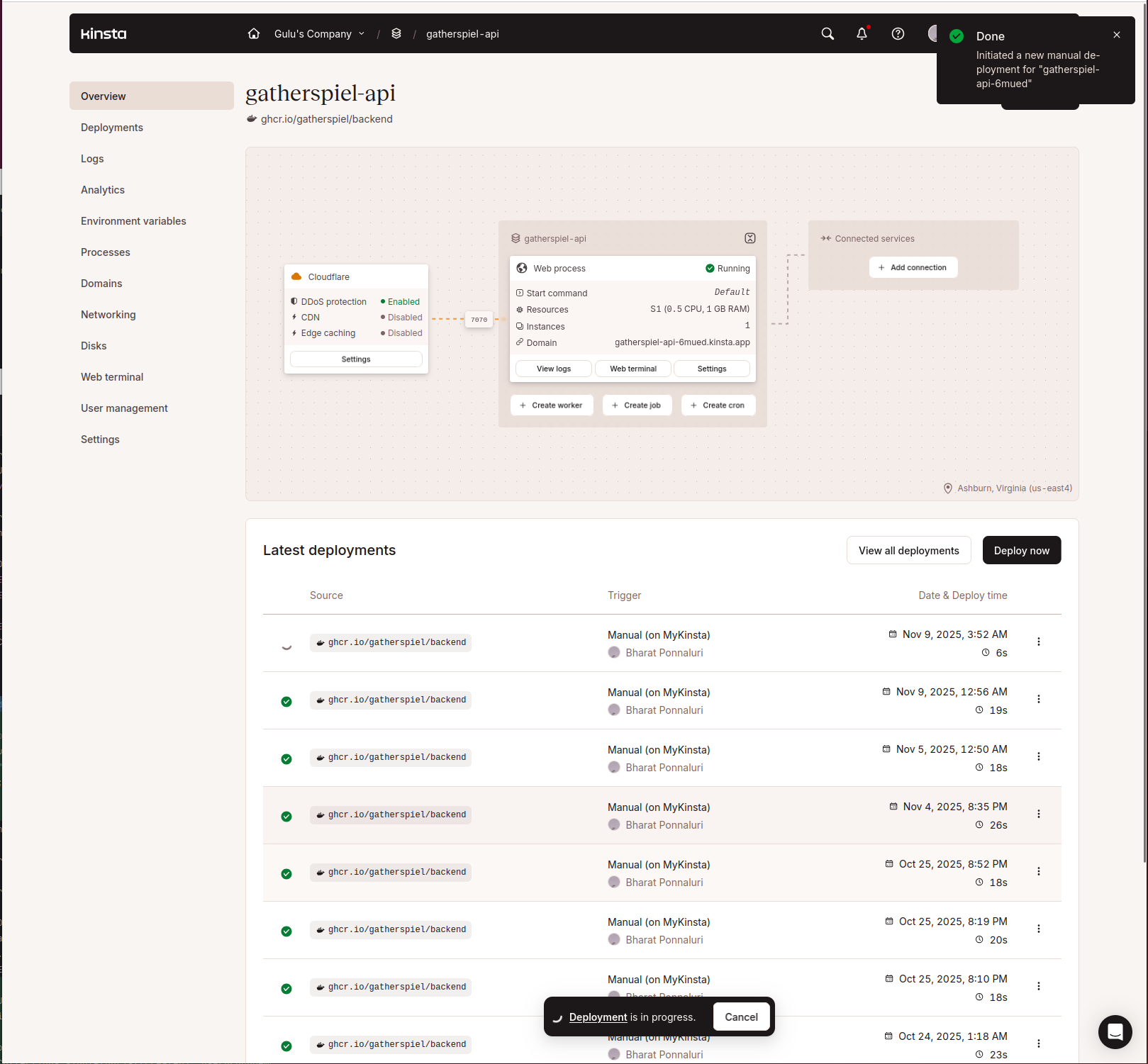
After the release build was complete, I started a production deployment.

After the deployment, my user page correctly showed the next occurrence of the two events I host on November 9th.

Thoughts about the cooperative card game The Gang!

On Wednesday night, I played a cooperative card game called The Gang for around 2 hours. The Gang is a cooperative adaptation of Texas Hold’em where players have to guess how good their hand it relative to other players.

A round of The Gang starts with players drawing 2 cards and then taking a chip to represent how strong they think their hand is. The chips have a number of stars ranging from 1 to the number of players in the game. Then there are 3 more rounds where cards are revealed, players reasses the relative strength of their hand, and then take a chip. During the 4 round, the chips players take have to correctly represent the

There are 1326 possible poker hands. A binary search to find a value in data that has 1326 items would take up to 11 iterations.

There are 6! ways that players can take chips. As a result, the way players represent chips can represent up to 9 bits of information. Players have 3 rounds to take chips before they have to take chips correctly representing the strength of their hand. This represents 27 bits of information, which is not enough to communicate the exact contents of people’s hands, even when considering the fact that the game is played with a standard 52 card deck without duplicates.

I think the fact that players have to communicate the relative strength of their hand over multiple rounds instead of simplify taking chips to communicate the exact cards in their hand is a brilliant design.

View models and JavaScript UI libraries

I was looking at two JavaScript libraries, reactive, and ripple.js that use view models to dynamically render html. This made me think about the design of my framework, places.js, which uses a state based approach like the following example.

import {BaseDynamicComponent} from "@bponnaluri/places-js";
import {IS_LOGGED_IN_KEY, LOGIN_STORE} from "../../data/auth/LoginStore.ts";

export class OpenCreateGroupComponent extends BaseDynamicComponent {
  constructor() {
    super([{
      componentReducer:(data:any)=>{
        return {
          [IS_LOGGED_IN_KEY]: data?.loggedIn
        }
      },
      dataStore:LOGIN_STORE
    }]);
  }

  override getTemplateStyle():string{
    return `  
      <link rel="stylesheet" type="text/css" href="/styles/sharedHtmlAndComponentStyles.css"/>
      <style>
        a {
          color: white;
          text-decoration: none;
        }    
      </style>`
  }

  render(data: any){
    const url = data[IS_LOGGED_IN_KEY] ?
      `html/groups/create.html` :
      `/html/users/createAccount.html?message=Register_an_account_and_log_in_to_create_a_group`

    return `
        <a href ="${url}">Create group</a>`

  }
}

The data passed into the render method is a regular JavaScript object without type checking. For example, in the component below, if I tried to render the url using the templated string <a href ="${data.url}">Create group</a>`, the component would render a link with an undefined value.

Adding a view model would be one way of adding type checking to this code. I think it would also provide additional value for more complex components. However, I don’t think I should add view models to places.js.

The additional code needed to create view models would mean increased costs with maintenance complexity. Having less code means reduced maintenance complexity.

Adding view models to places.js would mean bugs in the framework that would cost time to fix. The extra complexity would also make it more difficult to make necessary updates to places.js in the future.

I want to make the source code of dmvboardgames.com and places.js approachable to anyone with a basic understanding of CSS, HTML, and Javascript. Adding view models would make the code less approachable.

  • The additional code needed to create view models would mean increased costs with maintenance complexity. Having less code means reduced maintenance complexity.
  • Adding view models to places.js would mean bugs in the framework that would cost time to fix. The extra complexity would also make it more difficult to make necessary updates to places.js in the future.
  • I want to make the source code of dmvboardgames.com and places.js approachable to anyone with a basic understanding of CSS, HTML, and Javascript. Adding view models would make the code less approachable.
  • If a developer decides to use view models with places.js, they can extend the BaseDynamicComponent class in places.js to implement view models. As a general rule, I think it is better for other developers to extend the framework to meet the needs of the product they are building. If I implement view models, it is likely that I won’t implement them in a way that precisely meets the needs of other developers. Also, for developers who decide not to use view models, they will be unnecessary complexity. If I add support for the optional use of view models, I’ll have to spend more time maintaining places.js , which will mean I have less time to focus on improving the quality of places.js.

It has been around a month since I last made an update to places.js. Over the past month, I have been actively using places.js to develop new UI components for dmvboardgames.com, and there haven’t been any bugs on the website related to places.js. Modifying a code that has been working reliably for an update that may not be useful is an unnecessary risk.

I’m also making significant changes to the backend to support users joining groups, and I’ll likely be making additional changes. These changes are likely to have bugs, and making changes to places.js will obscure the source of bugs. It is normal to have bugs in software, and it’s impossible to consistently write 100% bug free code on the first try. On the other hand, steps can be taken to make sure the source of a bug can be quickly identified, so that a change can be made to fix it.

If a developer decides to use view models with places.js, they can extend the BaseDynamicComponent class in places.js to implement view models. As a general rule, I think it is better for other developers to extend the framework to meet the needs of the product they are building. If I implement view models, it is likely that I won’t implement them in a way that precisely meets the needs of other developers. Also, for developers who decide not to use view models, they will be unnecessary complexity. If I add support for the optional use of view models, I’ll have to spend more time maintaining places.js , which will mean I have less time to focus on improving the quality of places.js.


To add type safety in the future, I think an alternative solution could be to look into somehow leveraging TypeScript as places.js already uses TypeScript.

In the immediate future, I think updating the constructor to use an updated reducer would be a good way of reducing complexity.

 componentReducer:(data:any)=>{
   let url = "html/groups/create.html"
   if(data?.loggedIn){
     url = "/html/users/createAccount.html?message=Register_an_account_and_log_in_to_create_a_group"
   }
   return {openUrl:url}
 },

Then, the render method could be rewritten as follows.
render(data: any){
 return ` <a href ="${data.openUrl}">Create group</a>`
 }