Category Archives: Uncategorized
Updated rules for simultaneous play area control game
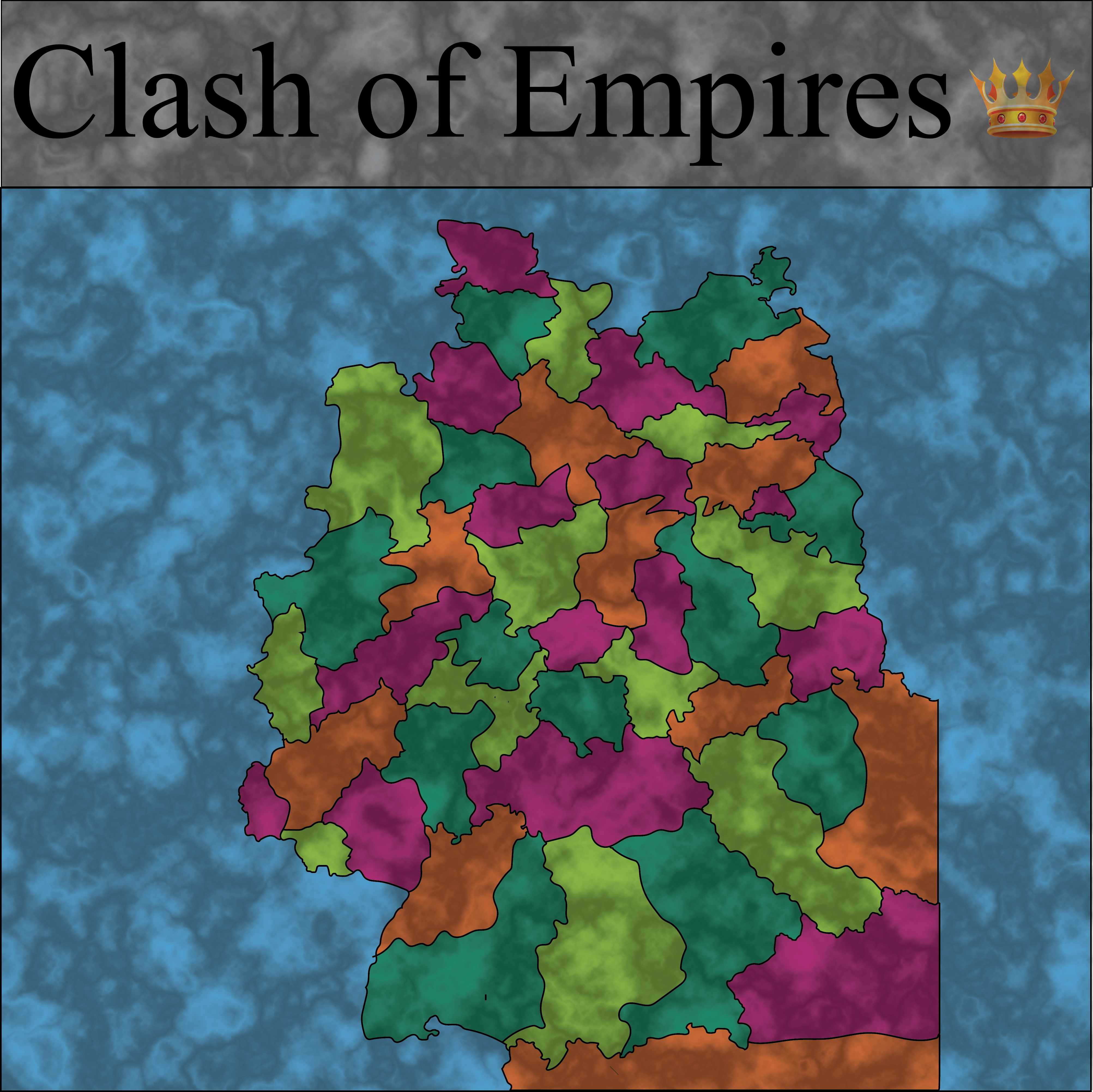
Germany Map Draft
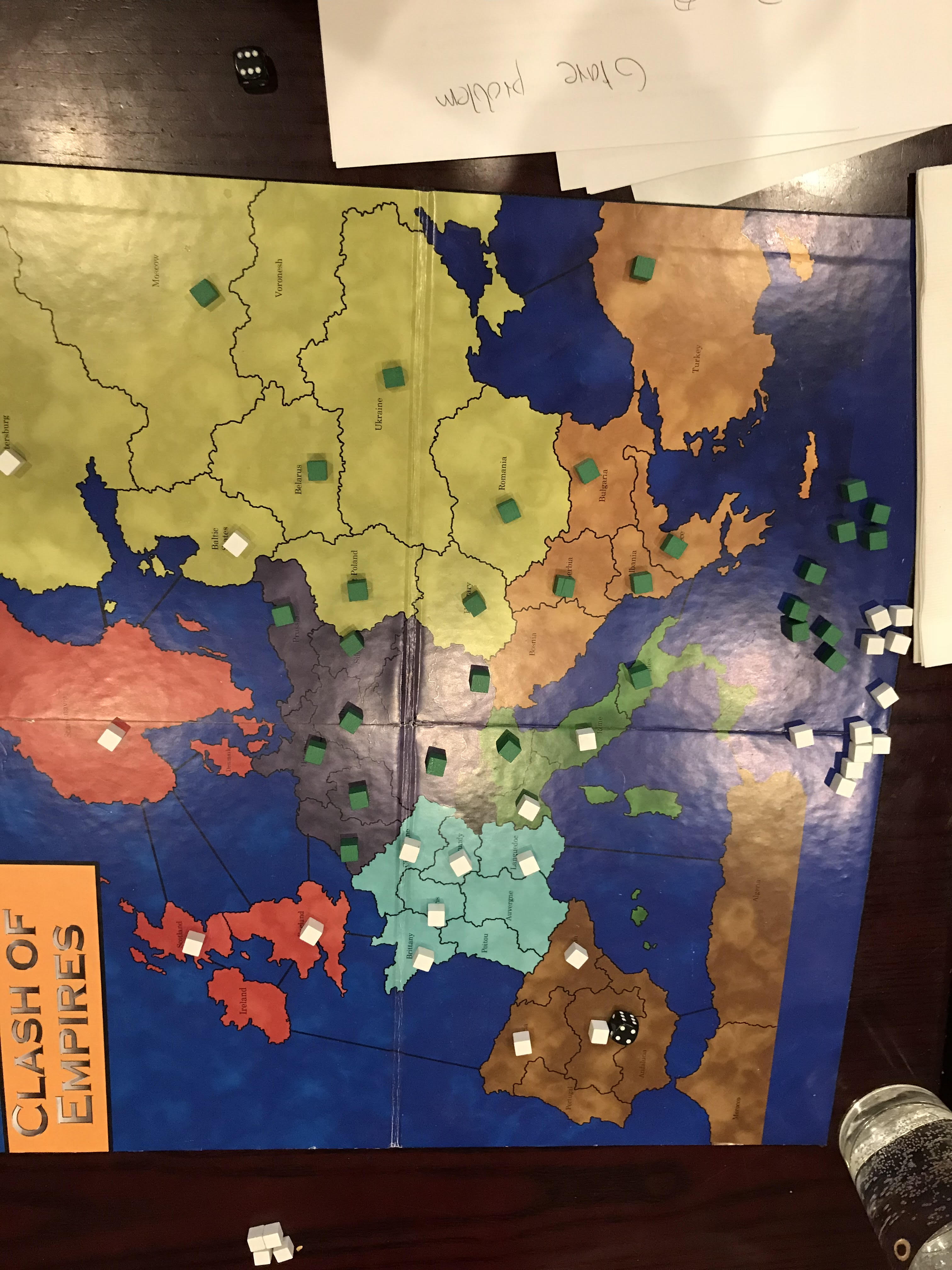
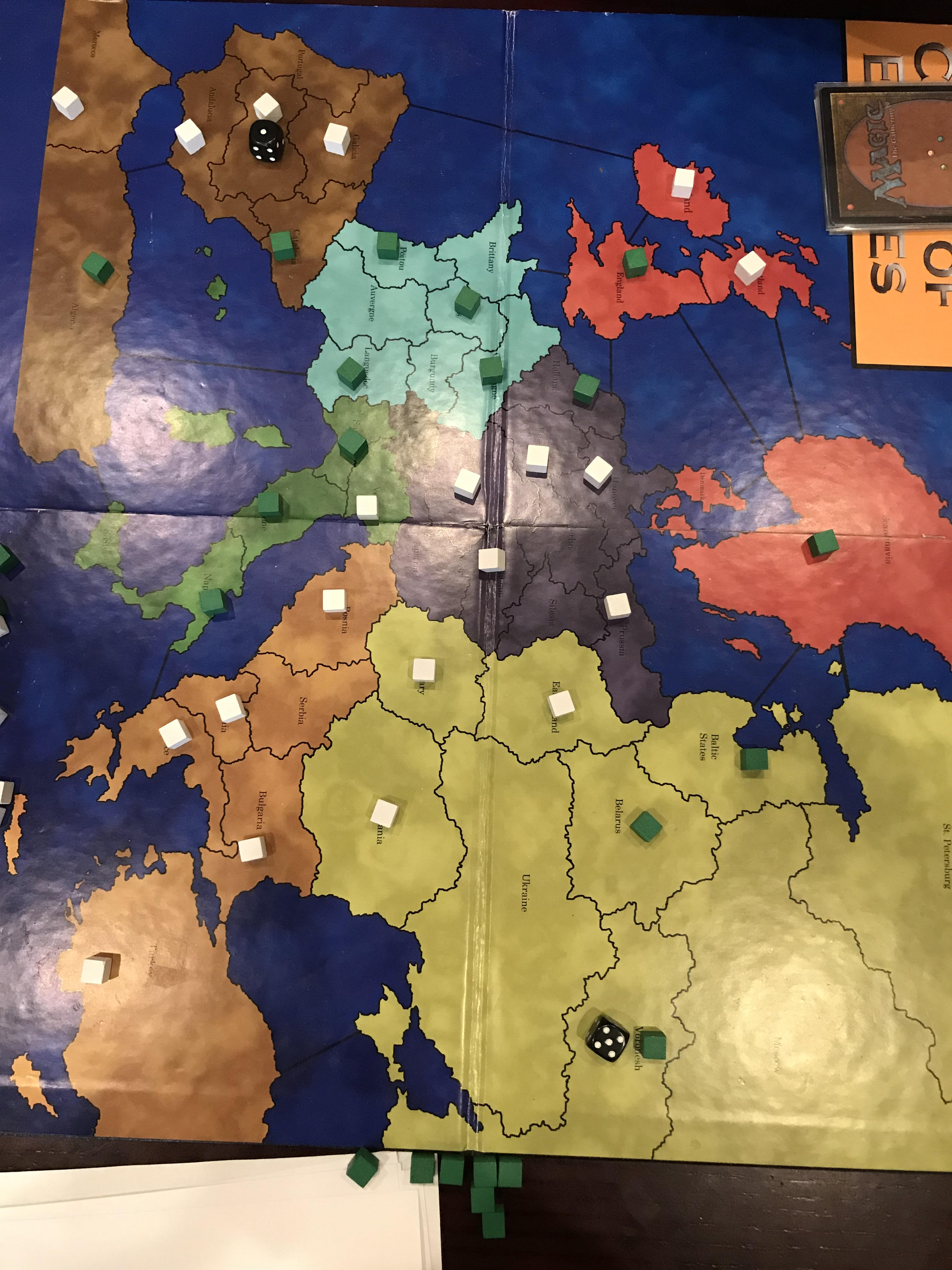
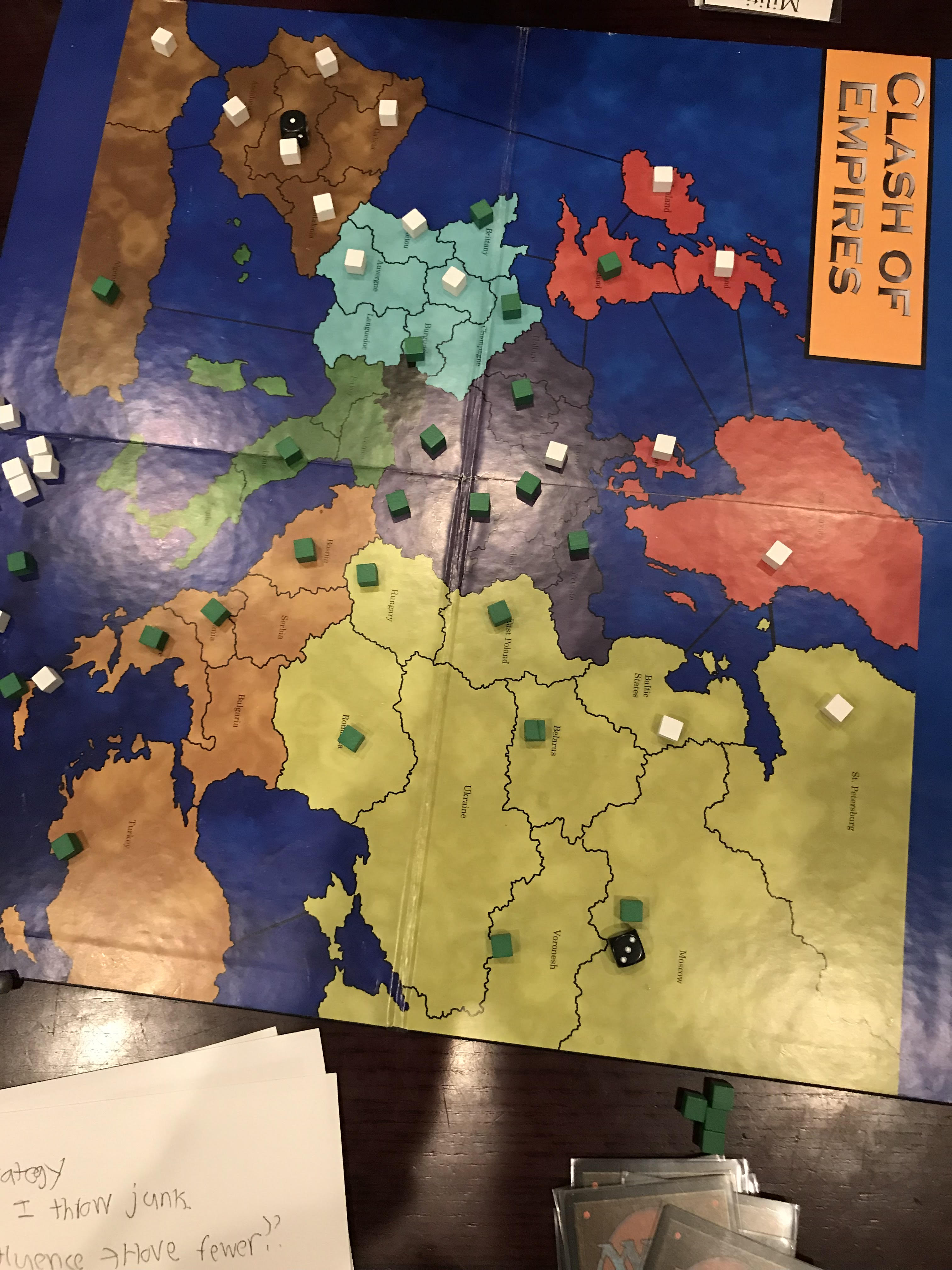
Pictures from December Playtest
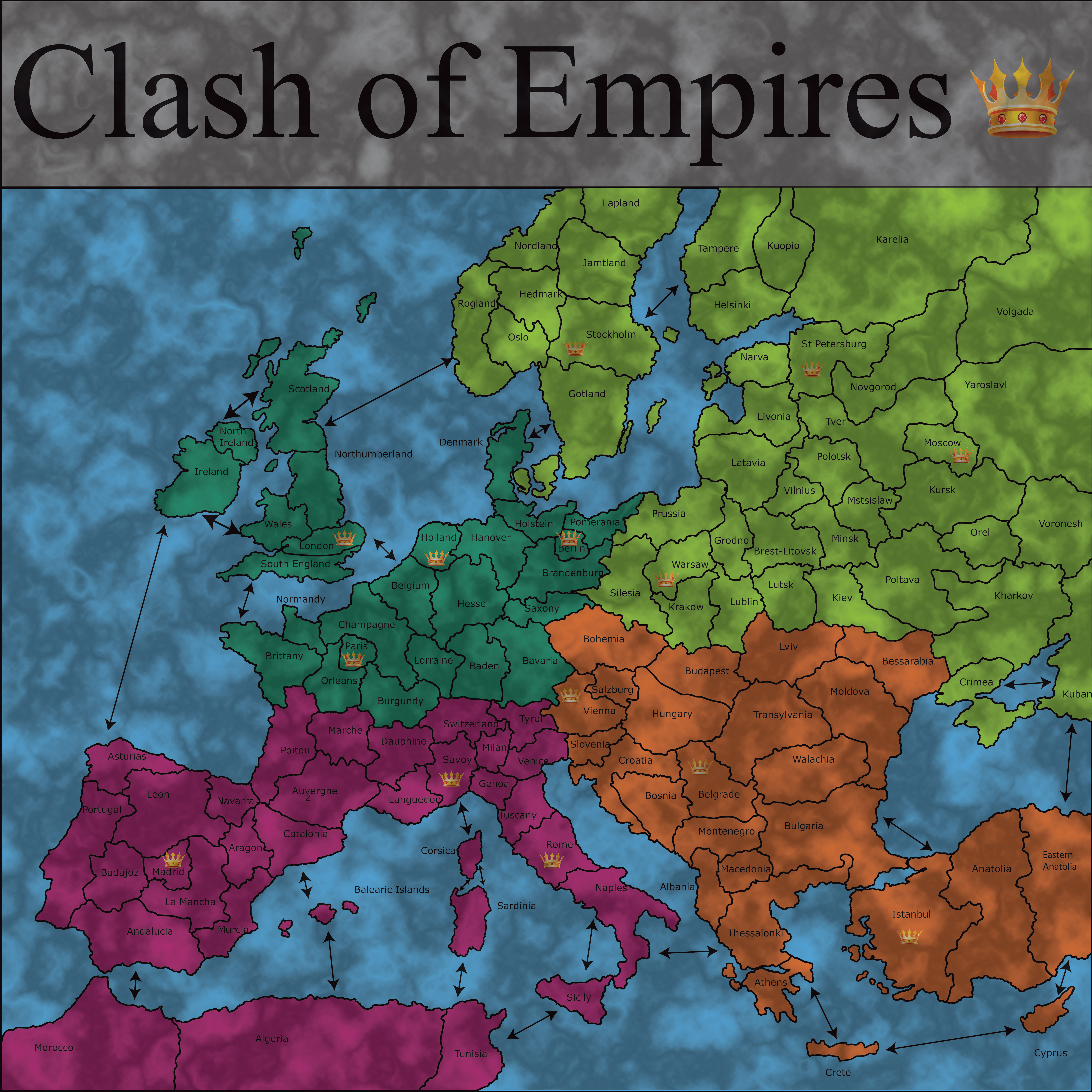
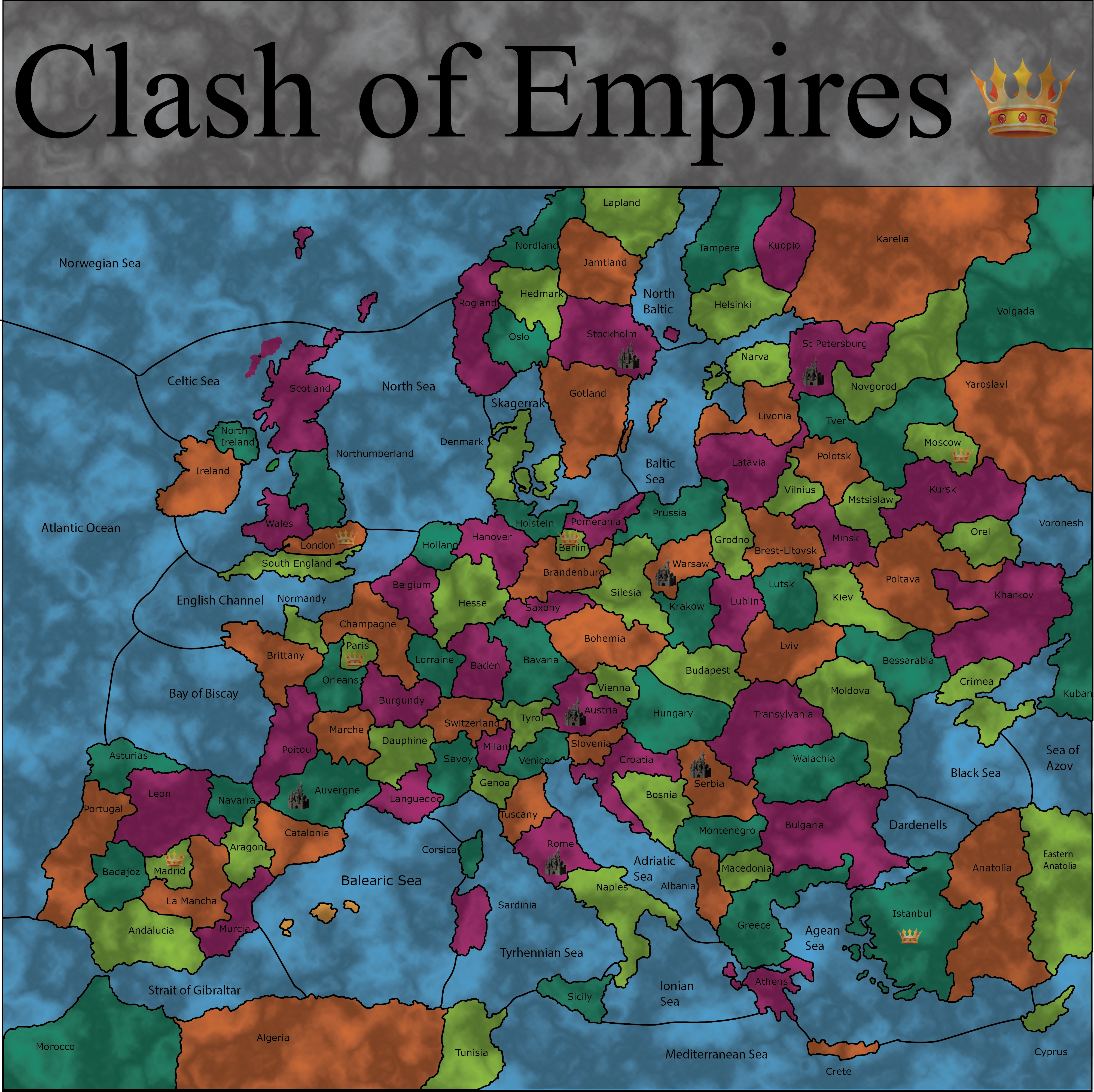
Updated Europe Map
Clash of Empires Morale System
When playtesting Clash of Empires, I noticed that many games end up with one player having an overwhelming advantage in terms of territory or position when the game isn’t close to over.
To fix this, I plan to introduce a morale system to allow players with an early advantage to quickly end the game. There will be a single morale tracker, that will move when a player removes enemy influence. Also a player will gain morale each turn for occupying strategic locations. They win the game if the morale tracker moves enough spaces in their direction. If the game end is triggered before one player wins a morale victory, a player gains points equal to the number of territories controlled plus their position on the morale track.
In addition, the morale system has many other strategic implications. First of all, it is a lot more dangerous for a player to neglect the board early game in favor of improving their deck because the other player will get a morale victory. Second, players will now be more willing to take risks, especially if they are losing in order to quickly win a morale victory. This will make the board more dynamic, and the game will be less likely to devolve into a stalemate near the end.
New Combat System for Clash of Empires
During my playtests of Clash of Empires, I have noticed that the combat system has some major problems and needs a rework. Players have complained that combat is too predictable, and that high value combat cards are overpowered. I have also noticed that attacking is often not worthwhile since combat often ends up in a draw.
With the new combat system, players play 3 cards from their hand instead of one. Each card has a suit and a number, and the winner will be the person who played the most suits. To prevent draws, tiebreakers will be used in the following priority.
- Most numbers in a row.
- Highest total value.
Going for the highest value card early is now a bad strategy, and players should spend more time buying low to mid value cards. Early game, it is best to buy some low value cards to add more suits to your deck since they are easy to get, and some mid level cards because they are good for tiebreakers. High level cards are only good late game to help with having the most numbers in a row and possibly the highest total value.
For the starting deck, a player starts off with 8 combat cards, 2 recruits, 2 attacks, and 8 influence. Each of the combat card has a value of 2, and has be of the same suit. The influence, recruit, and attack cards also have the same suit, but have a value of 0. To start the game off, all the influence goes on the top of the deck and everything else is shuffled. This allows players to build up some influence on the board before actually fighting.
Clash of Empires Stock Variant
I was thinking about ways to make Clash of Empires work for more than 2 players. This week, I came up with a variant where players trade “shares” in countries that are fighting each other on the board. The winner is the person who makes the most money at the end of the game.
There are two things I want to accomplish with this variant. First of all, control of a country is based on being the majority shareholder, and you can make money by buying shares in countries you do not own. This adds a new layer of strategy as players need to predict how the board position will change and make investments in the right country. Second, the value of a country’s shares increases based on how fast that country is expanding. Players will be encouraged to make a country rapidly expand, then sell its shares to make a big profit. This encourages dynamic board positions as players abandon a large country for a smaller one that can rapidly expand and take the place of the overextended large country.
The game will be played over a number of turns , each split up into several phases.
Investment Phase: For each player in the game, create an individual pile of x stocks, and place them to the side of the board. Afterwards, players can bid on stocks. On a player’s turn, they pick a pile of stocks, and then place a bid on that pile. Their bid must be higher than any previously existing bids. Players keep going until everyone has the highest bid on 1 pile.
Control Phase: If a player has the most stocks, they get control of a country. In case of a tie, control does not change. If nobody previously had control of a country, then the player who bought a stock of that country from the leftmost pile gains control.
Action Phase: Starting with the first player(first player rotates counter-clockwise), and moving clockwise, each player picks a country they have majority control in, and performs an action round with them. Then, starting clockwise from the first player, anyone who doesn’t have majority shareholder in a country, may take actions with a country that hasn’t done anything that turn.
Here is how an action round for a country works.
-Majority shareholder places troops in a county equal to its reinforcement value. To figure out the reinforcement value, count the number of regions a country owns, and divide that by 2 rounded down. Troops can only be placed in a country’s home regions.
-Move troops. Majority shareholder can move each troop to an adjacent region. If there are enemy troops in the same region, combat happens. Keep removing one troop for the active country, and one troop for the defending country until one country is out of troops. If the defender runs out of troops, and the active country still has at least one troop, the active country takes control of the territory.
-Sell shares. Starting with the active player and moving clockwise, a player can sell shares in a country to get money. The value of a country’s share is based on the number of regions that country controls. During the last round, players automatically sell their shares.
After playing a fixed number of rounds, the game will end. The player with the most money wins.
Assorted riddles and trick questions
Found a bunch of a riddles and trick questions I learned as a kid.
Q: How much dirt is in a 4ft x 4ft hole.
A: None, there is no dirt in a hole.
Q: Say shop.
Q: Spell shop.
Q: What do you do at a green light?
Q: Which came first, the chicken or the egg?
A: The egg.
Q: A man has 1 match, 1 lantern, 1 stove, and 1 heater. What does he light first?
A: The match.
Q: Say silk 5 times.
Q: Spell silk.
Q: What do cows drink.
Q: A plane crashes on the border of the US and Canada. Where do you bury the survivors?
A: You don’t bury survivors.
Q: Say fort.
Q: Spell fort.
Q: What do you have soup with?
Q: You are driving a bus. At the first stop, 10 people get on. At the second stop, 5 people get off. At the third stop, 3 people get on, and 13 people get off. Who is the bus driver.
A: You.
Q: Jack’s mom has 5 sons, the first son is named firstCup, the second son is named secondCup, the third son is named thirdCup, and the fourth son is named fourthCup. What is the name of the
fifth son?
A: Jack.
Q: What is the center of gravity?
A: The letter V.
Q: Spell my name.
A: M-Y-N-A-M-E.
Q: A man an a woman go on a honeymoon to Paris. In Paris, the woman falls of the balcony and the man says it was a suicide. However, an airline official says: “This was not a suicide, it was a murder”. How did he know?
A: The man only buys a one way ticket for his wife.
Updated Rules
After the latest Clash of Empires playtest in July, I decided to experiment with some major changes. It did not scale well because adding more players would end up making the game take too long, and there were balance issues with odd numbers of players.
In January 2015, I came up with a variant that made two major changes.
The first change was that players would secretly invest in certain factions on the board, and would earn points at the end of the game based on the success of those factions. Many multiplayer area control games suffer from excessive leader bashing or targeting a specific player based on factors outside the game. With secret investments, it is harder to figure out the leader or target a specific player. Additionally, things would be faster because players will not be able to slow the game down by trying to calculate points.
The second change was that each player made simultaneously took their turn. Players would secretly play cards from their hand representing a territory, and a specific faction that would get a unit there. This meant that I could easily add more players without making the game take significantly longer. I playtested this variant, and it seemed to go well. However, I decided not to implement the variant because it was too much of a change.
Due to the issues I had during the July playtest, I decided that some radical changes were needed. As a result, I revisited the variant I had made 18 months earlier and decided to try testing them again.
In addition to the rule changes, I decided to make a map of the US. Territory names were important, and I wanted to have ones that people would recognize.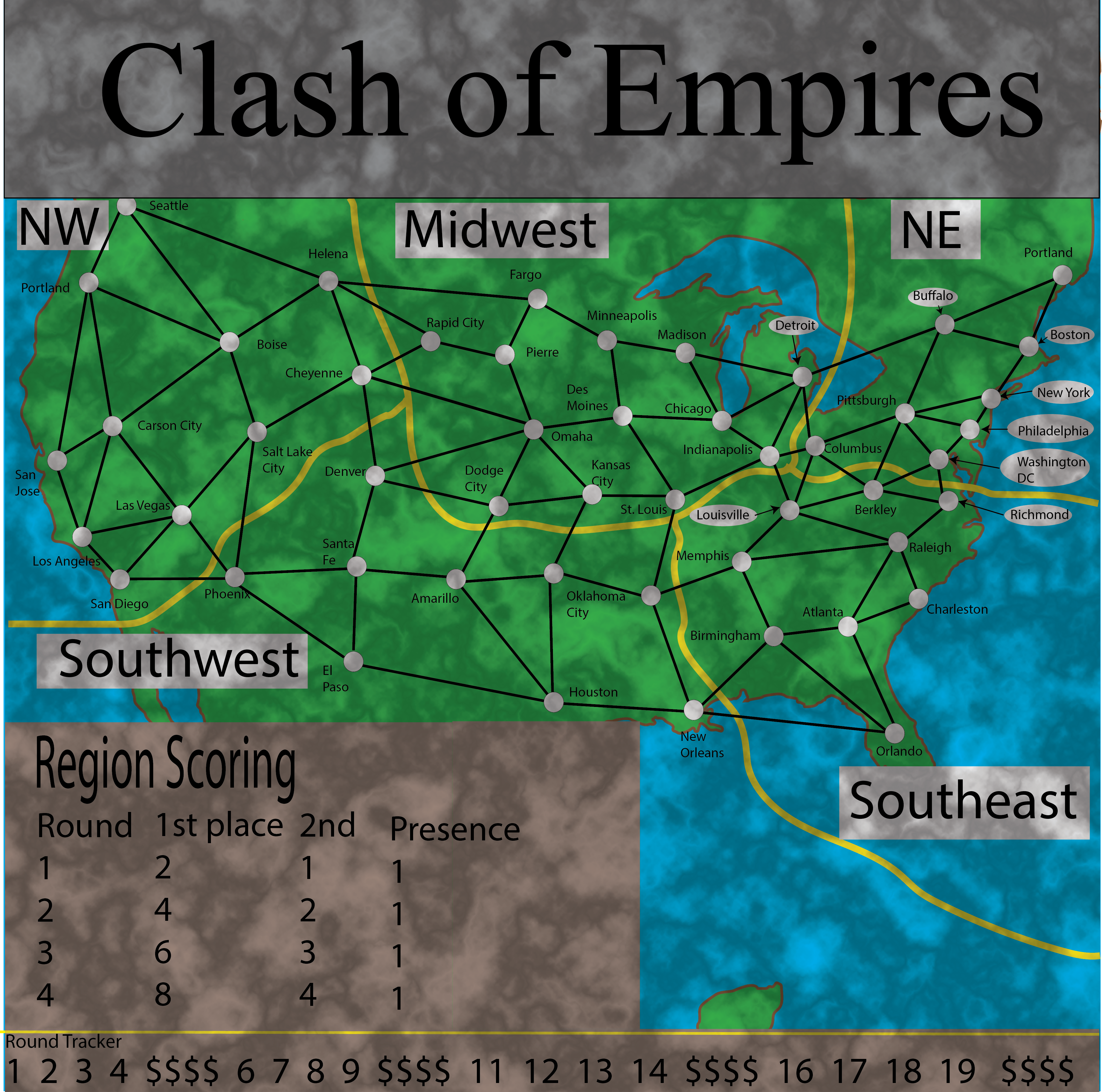
Additionally, I decided to make the theme revolve around fast food corporations. Many players did not like the old historic theme, and I felt fast food was a theme more people would like.
The playtesters liked the secret scoring mechanics, and the short playtime was also appealing to them. For the next playtest, I’m going to continue working on this variant, and focus on the following gameplay changes.
- Add special action cards: Players said they wanted more ways of influencing the game state aside from placing units on the board. To address this, I plan to add special action cards that give various bonuses such as reducing a company’s endgame score.
- Fewer territories: Players have cards in the hand that refer to specific territories. This was an issue because the map had over 50 territories, and finding some of them took time. Companies would score multiple times throughout the game, and having a large number of regions made scoring tedious. To fix this, the number of territories on the updated map will be significantly reduced.
- Rework combat: Combat occurred every turn because a players turn usually involved playing a company’s unit in a rival territory. Resolving combat took time and significantly slowed down the game.. Additionally, combat was based on a die roll, which left players frustrated when a bad roll made their turn meaningless. In the future, multiple companies can have units in the same territory, and combat will be triggered by special cards that will only show up every few turns. Players will also have more control over combat results.