All posts by bponnaluri@gmail.com

Theory about how large language models represent knowledge


I have a theory that LLMs have sections representing various areas of knowledge. They are trained to recursively split up input, send them to the relevant sub sections, and then logically connect them together at the end. Below are some thoughts explaining my logic behind the theory and some relevant research I found.

Until more conclusive research is found, this theory should be treated as speculation, and not an authoritative explanation of how LLMs represent knowledge. While I don’t plan to use LLMs for my work, I want to understand how they work.

Why this theory makes sense to me

Recently, I’ve noticed many people have found LLMs such as Anthropic Claude, ChatGPT, and Github Copilot to be helpful for their work. Output generated by these LLMs suggests that they have advanced beyond just memorizing outputs based on their inputs and have some sort of knowledge.


Trying to train a model to have knowledge by simply searching for points that are close to optimal or optimal is impractical with billions of dimensions. I also don’t think methods used to help train models such as gradient descent work with billions of dimensions. To me, it appears that LLMs use techniques to reduce the number of dimensions they are looking at when training..

If requests can be routed to different sections of the model based on their subject, that can be a way of reducing dimensions. For example, if there was a 100 million parameter model that was designed to answer history and math questions, the model could be effectively split into a 50 million parameter history submodel, and a 50 million parameter math submodel. These submodels could then be recursively split up into smaller submodels to reduce dimensions.

I was also thinking about how students learn in school. Students don’t learn calculus by looking at a bunch of questions, memorizing them, and then adapting them into actual knowledge. Learning a foreign language doesn’t mean memorizing translations, and then becoming a fluent speaker. Learning calculus means learning to recognize numbers as a young child, learning basic arithmetic, and then slowly learning more advanced math until you know enough to understand calculus. This is analogous to having submodels representing different areas of math and then logically connecting them together.

My Thoughts on using LLMs and relevance to this theory.


I think the productivity gains people are seeing from using LLMs is due to the fact that their costs are being subsidized. Once LLM owners stop subsidizing LLM costs, they will become too expensive to be useful for most people. One reason I don’t work with LLMs is because I don’t want to be dependent on them and suddenly have to pay more for them when prices increase. I also think it will be hard to avoid the temptation to use LLMs in places where they are ineffective due to inputs or outputs that can’t be quantitatively defined.

If LLMs are split up into smaller sections representing specific areas of knowledge, that also means that general purpose LLMs that are commonly used today aren’t the most efficient way of getting work done. It would then be better to have smaller, more specific models. Also, smaller specific models would help ensure that AI is used in areas where it is useful due to quantitatively defined inputs and outputs.

If the theory about LLMs consisting of smaller submodels is correct, this also means that the way they are trained could be improved. An task-specific LLM could be trained through multiple iterations with different sizes of data. The first training phase could be on training with small items of data representing simple concepts to build the small submodels. Afterwards, the models could then gradually increase the size of the data items used during subsequent training phases. This would help the model gradually build larger submodels that are logically linked together.

One practical use of this technique could be improving the accuracy of weather predictions. A model could be trained to understand to understand math using the multi stage training process described in the previous page. The model could be trained to understand basic laws of physics at a conceptual level such as gravity and momentum with the result going in a separate section of the model. Another section of the model could be trained to understand concepts relevant to weather such as the amount of sunlight that will reach an area based on the earths orbit and rotation around the sun. Then, there could be another training round that would make sure the submodels are logically combined.

Some relevant research I found

  • https://arxiv.org/pdf/2412.19260v1

  • Garcia, Mirian H., et al. “EXPLORING HOW LLMS CAPTURE AND REPRESENT DOMAIN-SPECIFIC KNOWLEDGE.” Arxiv, vol. 2504.1687, no. 2, 2025, pp. 1-21. Arxiv, https://arxiv.org/pdf/2504.16871.

  “ The hidden state traces in autoregressive models showed consistent clustering around domain-specific queries. When samples from the Specialized Pool were introduced, a clear separation between domain-related queries emerged, indicating that these models are capable of distinguishing between domain-related requests beyond simple semantic similarities.”

Toaster Trouble

Recently, I came up with the idea of a hidden role game based on the idea of robotic toasters invading Earth. The idea was inspired by the Battlestar Galactica episode where the humans are trying to escape from a planet occupied by the Cylons.

61+8FkAqKiL._AC_SL1200_

A draft of the rules can be viewed here.

Clash of Empires Morale System

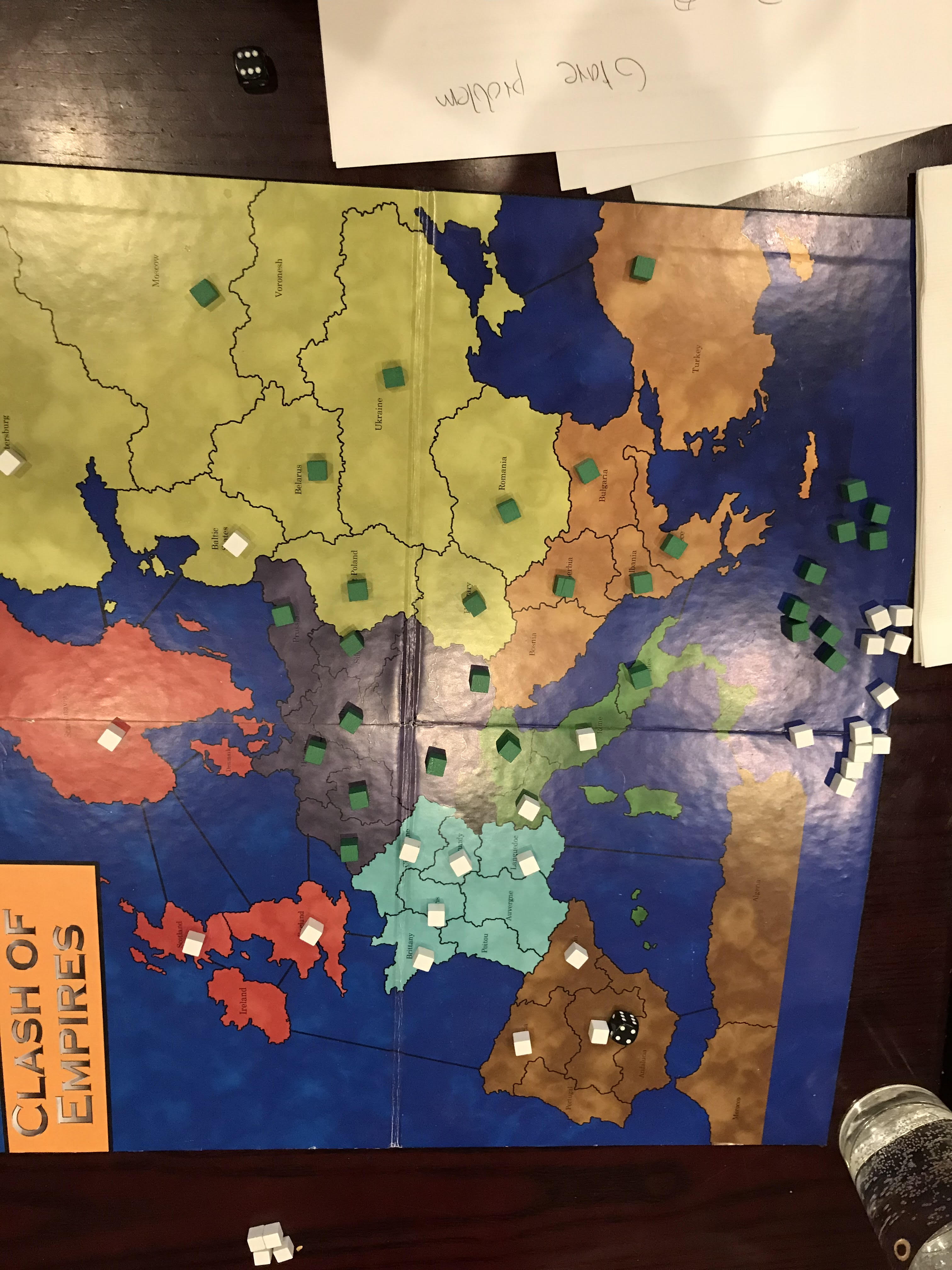
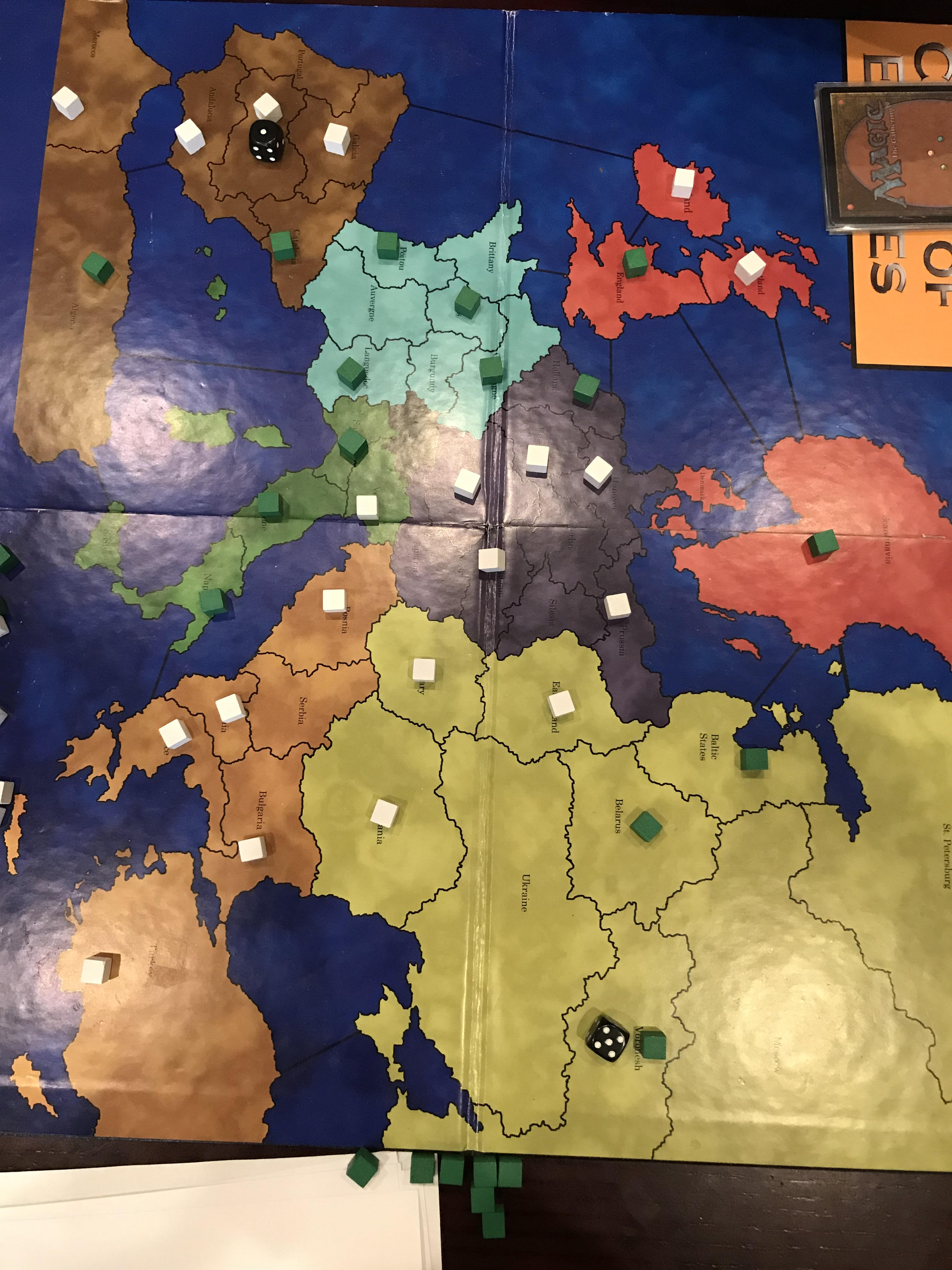
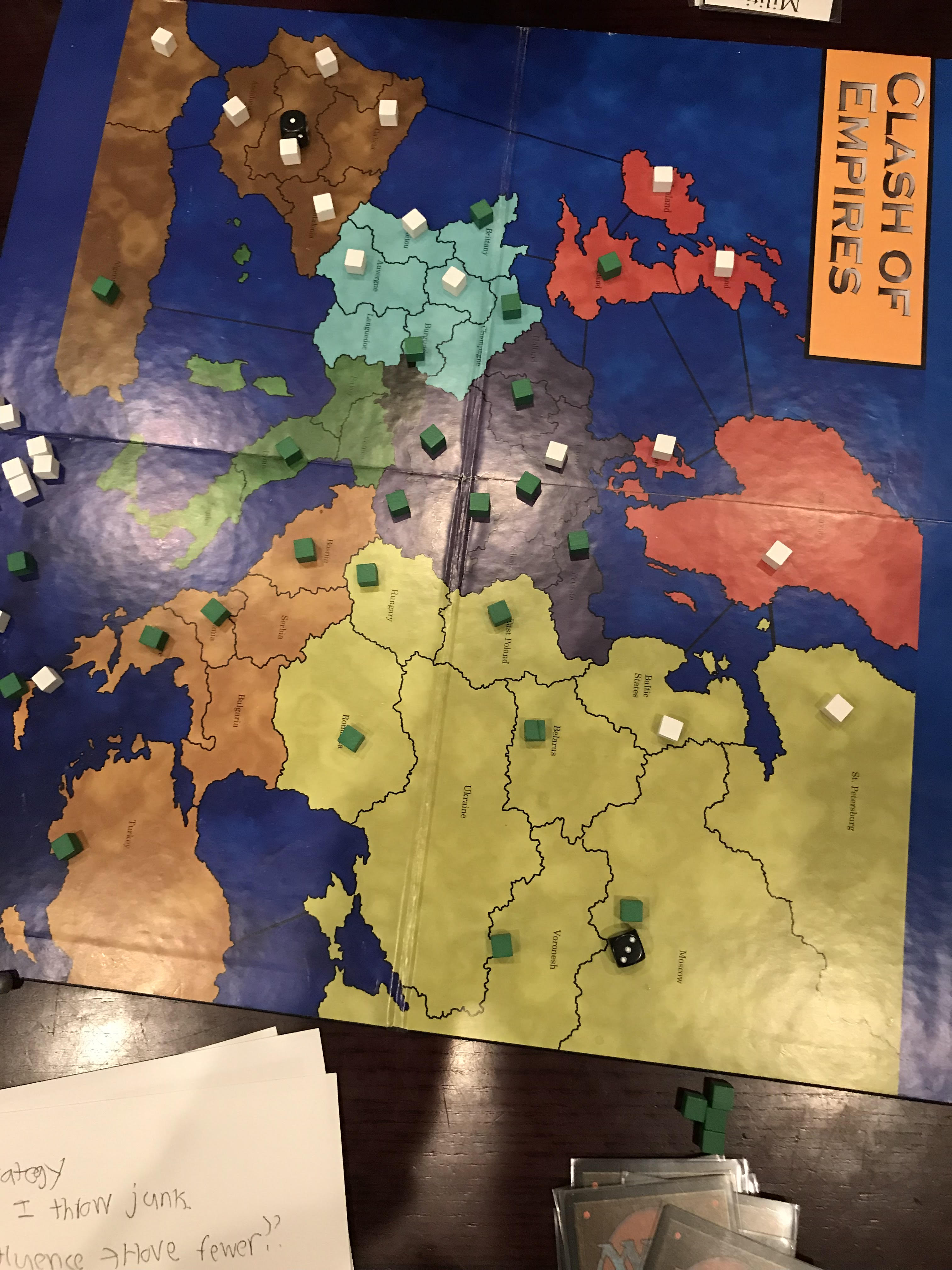
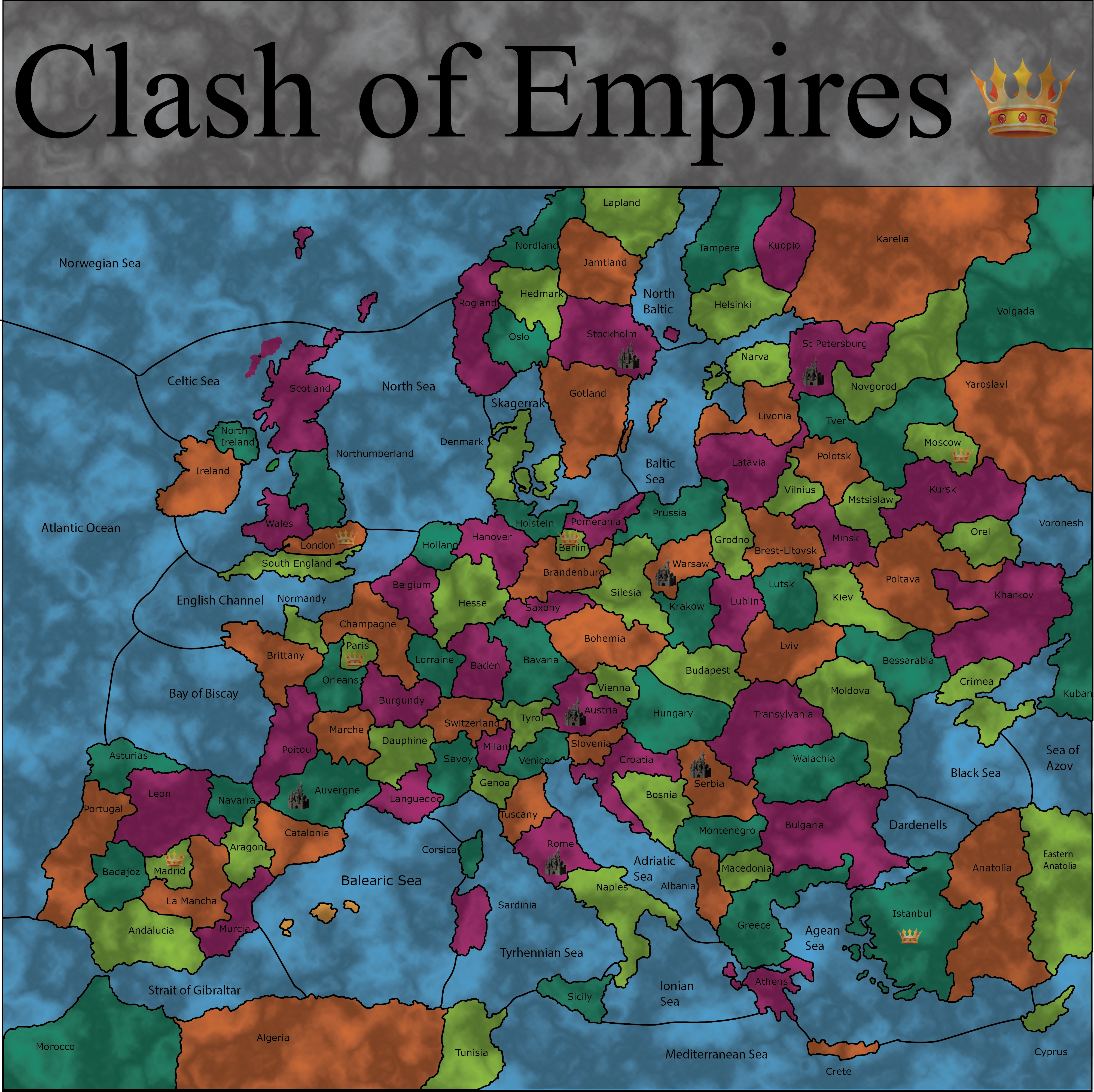
When playtesting Clash of Empires, I noticed that many games end up with one player having an overwhelming advantage in terms of territory or position when the game isn’t close to over.

To fix this, I plan to introduce a morale system to allow players with an early advantage to quickly end the game. There will be a single morale tracker, that will move when a player removes enemy influence. Also a player will gain morale each turn for occupying strategic locations. They win the game if the morale tracker moves enough spaces in their direction. If the game end is triggered before one player wins a morale victory, a player gains points equal to the number of territories controlled plus their position on the morale track.

In addition, the morale system has many other strategic implications. First of all, it is a lot more dangerous for a player to neglect the board early game in favor of improving their deck because the other player will get a morale victory. Second, players will now be more willing to take risks, especially if they are losing in order to quickly win a morale victory. This will make the board more dynamic, and the game will be less likely to devolve into a stalemate near the end.

New Combat System for Clash of Empires

During my playtests of Clash of Empires, I have noticed that the combat system has some major problems and needs a rework. Players have complained that combat is too predictable, and that high value combat cards are overpowered. I have also noticed that attacking is often not worthwhile since combat often ends up in a draw.

With the new combat system, players play 3 cards from their hand instead of one.  Each card has a suit and a number, and the winner will be the person who played the most suits. To prevent draws, tiebreakers will be used in the following priority.

  • Most numbers in a row.
  • Highest total value.

Going for the highest value card early is now a bad strategy, and players should spend more time buying low to mid value cards. Early game, it is best to buy some low value cards to add more suits to your deck since they are easy to get, and some mid level cards because they are good for tiebreakers. High level cards are only good late game to help with having the most numbers in a row and possibly the highest total value.

For the starting deck, a player starts off with 8 combat cards, 2 recruits, 2 attacks, and 8 influence. Each of the combat card has a value of 2, and has be of the same suit.  The influence, recruit, and attack cards also have the same suit, but have a value of 0. To start the game off, all the influence goes on the top of the deck and everything else is shuffled. This allows players to build up some influence on the board before actually fighting.

Clash of Empires Stock Variant

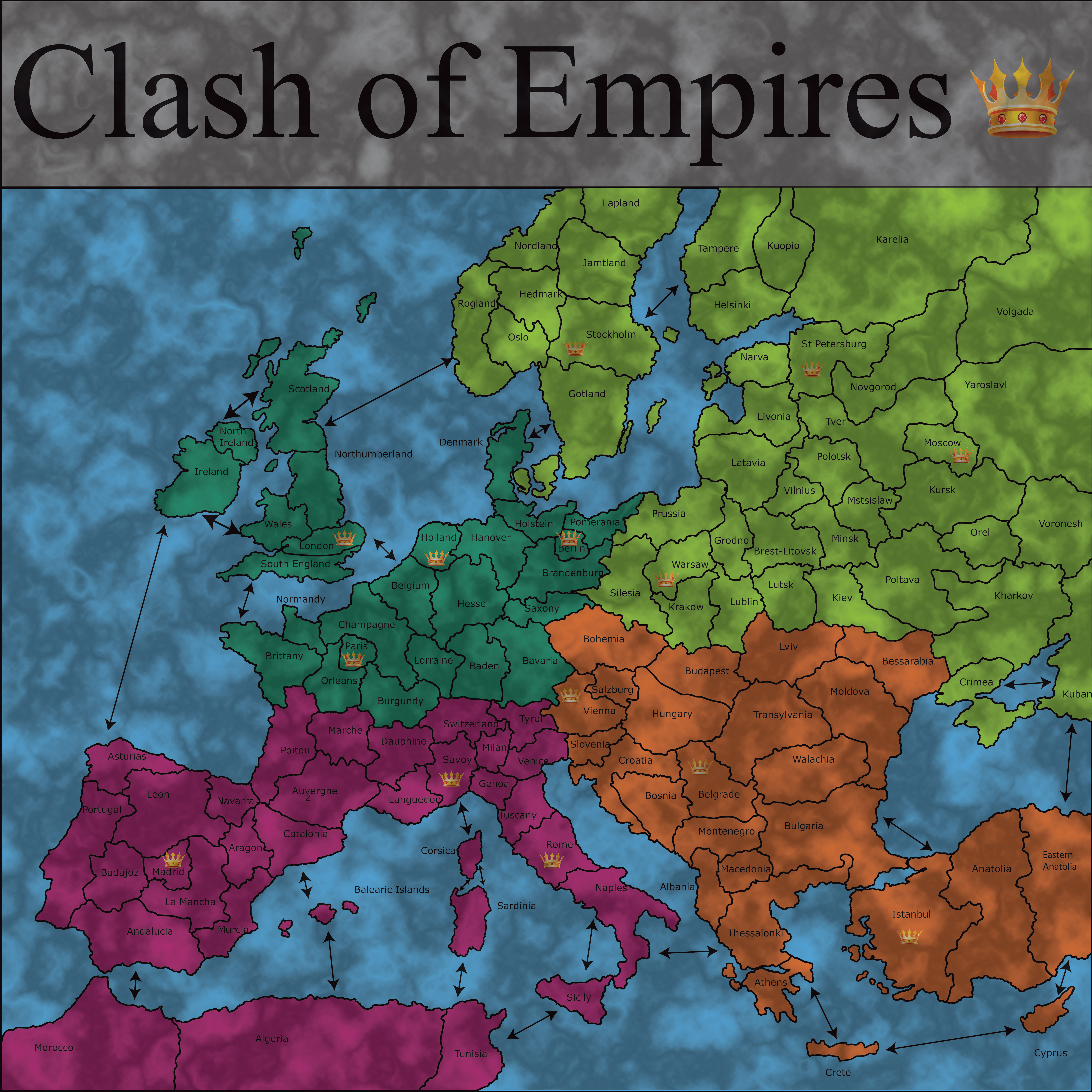
I was thinking about ways to make Clash of Empires work for more than 2 players. This week, I came up with a variant where players trade “shares” in countries that are fighting each other on the board. The winner is the person who makes the most money at the end of the game.

There are two things I want to accomplish with this variant. First of all, control of a country is based on being the majority shareholder, and you can make money by buying shares in countries you do not own. This adds a new layer of strategy as players need to predict how the board position will change and make investments in the right country. Second, the value of a country’s shares increases based on how fast that country is expanding. Players will be encouraged to make a country rapidly expand, then sell its shares to make a big profit. This encourages dynamic board positions as players abandon a large country for a smaller one that can rapidly expand and take the place of the overextended large country.

The game will be played over a number of turns , each split up into several phases.

Investment Phase: For  each player in the game, create an individual pile of x stocks, and place them to the side of the board. Afterwards, players can bid on stocks. On a player’s turn, they pick a pile of stocks, and then place a bid on that pile. Their bid must be higher than any previously existing bids. Players keep going until everyone has the highest bid on 1 pile.

Control Phase:  If a player has the most stocks, they get control of a country. In case of a tie, control does not change. If nobody previously had control of a country, then the player who bought a stock of that country from the leftmost pile gains control.

Action Phase:  Starting with the first player(first player rotates counter-clockwise), and moving clockwise, each player picks a country they have majority control in, and performs an action round with them.  Then, starting clockwise from the first player, anyone who doesn’t have majority shareholder in a country, may take actions with a country that hasn’t done anything that turn.

Here is how an action round for a country works.

-Majority shareholder places troops in a county equal to its reinforcement value. To figure out the reinforcement value, count the number of regions a country owns, and divide that by 2 rounded down. Troops can only be placed in a country’s home regions.

-Move troops. Majority shareholder can move each troop to an adjacent region. If there are enemy troops in the same region, combat happens. Keep removing one troop for the active country, and one troop for the defending country until one country is out of troops.  If the defender runs out of troops, and the active country still has at least one troop, the active country takes control of the territory.

-Sell shares.  Starting with the active player and moving clockwise, a player can sell shares in a country to get money. The value of a country’s share is based on the number of regions that country controls. During the last round, players automatically sell their shares.

After playing a fixed number of rounds, the game will end. The player with the most money wins.